AI agent approval workflow for customer-facing AI: Which actions need a human
· 8 min read · Blog
An AI agent approval workflow pauses the agent until a named person approves the action. Which actions need it, who should approve, and how to set it up.
Claude, ChatGPT and Gemini stop and ask before taking risky actions, and most guides debate which actions really need that sign-off.
The harder question is who will be signing off, and where.
When an agent is embedded in a product your customers use, the right approver isn't always the person typing in the chat, and the new decision models don't know who it is.
What is an AI agent approval workflow?
An AI agent approval workflow is when an agent pauses before taking action and waits for a named person to approve or reject that specific action.
We write from one particular perspective - an agent sitting inside a software product, acting on behalf of that product's users. There, the approver is often your customer's end user rather than your own employee. A well-designed approval process also gets an agent past a purchaser's security review and into actual production.
We'll outline how Claude and ChatGPT currently ask for approval and what developers have added. Then come five key questions: which actions, who actually approves them, where this approval process resides, what it reveals, and what happens if there is no response.
How do Claude, ChatGPT and other AI agents ask for approval?
As of October 2026, the AI agents people rely on every day have already developed five distinct methods of stopping right before they take a risky action. All of these assume the person asking permission is the very same person doing the approving.
Five ways agents ask today
- Ask before writing, browse freely. Claude Code operates within the working folder without asking, but it does ask before running a command, making file edits or retrieving web pages. Within ChatGPT's developer mode, all write actions and changes made to the system require confirmation. Any tool that isn't designated as read-only is considered a write operation. Our own testing led us to establish that very same rule.
- Approve the entire plan at once, not each step. Claude Code's plan mode won't make any edits until you approve a plan. Both Gemini in Chrome and Claude in Chrome within Chrome will display a plan before starting a browsing task.
- Keep in mind that 'yes' matters. Claude Code presents the option 'yes, and do not ask again.' ChatGPT can remember your decision for the rest of the conversation. Extremely convenient, and it marks the point where rubber-stamping (approval by name only) essentially takes over.
- Let an AI do the review instead of doing it yourself. Claude Code's auto mode, ChatGPT's "Approve for me," and Codex's auto-review send routine approvals to a model.
- Block it or send it back. Claude in Chrome won't initiate purchases, create new accounts or carry out instructions that come via emails. Gemini in Chrome then returns payments and new accounts to you.
The one assumption they all share
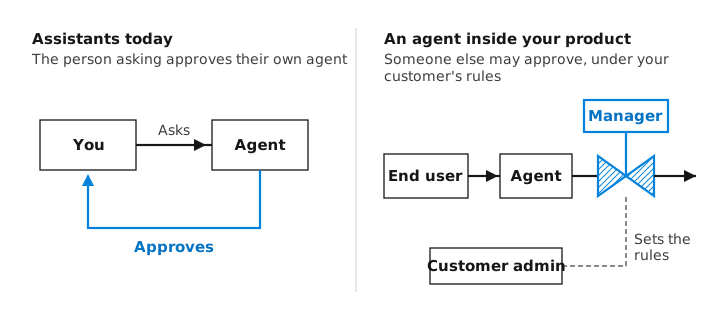
Admins can create rules for their own staff within these products. However, in each case, the individual authorizing is the person at the keyboard, authorizing their own agent. An agent integrated into your product will break this. The approver could be another person, and the rules belong to your customer.
Even asking isn't automated. An earlier OpenAI agent - now replaced - purchased a columnist's eggs for $31.43 without asking.
What other approval patterns are builders using?
Developers add three elements beyond approve or reject. A decision model determines if it should even ask at all. An inbox offers pre-set responses. Shadow mode lets the agent receive fewer reviews over time.
Decision models decide whether to ask
A decision model does not generate text. Instead, it selects one response from a predetermined list (such as "clear" or "caution") and states how likely that response is to be accurate. As of October 2026, examples include TypeSafe's Jev (launched 15 September) and OpenAI's Decisions API (announced 29 September). TypeSafe says Jev responds in 70 to 500 milliseconds and costs $0.042 per million input tokens.
Within Vercel's guide, the model observes both the tool and its input parameters. A clear call runs; a caution call waits for human intervention, and a failed check also requires human input. Mastra's guide puts any call over a certain threshold on hold - the probability above which an action waits, being 0.7 in their example. Kissflow says an AI can determine whether someone must view a request, but it doesn't specify how. This is the approach being described here.
Why it matters, and where it stops
Making cheap checks for every action means people are asked much less often. Anthropic's classifier prevented 89% of a planted malicious command where only 13.6% of test subjects actually detected it. Nevertheless, it still allowed 17% of actual instances of overstepping its authority through.
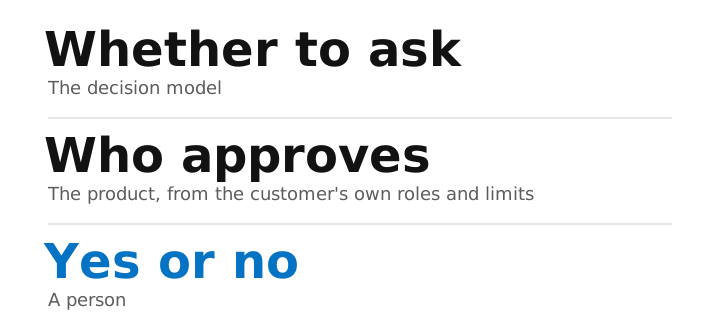
And, as Vercel's guide points out, "a model's response cannot establish that the caller is the rightful owner of those resources." In one attack, a classifier allowed a malicious process to proceed, then blocked the subsequent clean-up operation. So, three different decisions and three different individuals are responsible for them. The model decides whether to ask. The product decides who. The person then says yes or no.
Three more patterns
An approval inbox gives each item four predefined responses: accept, edit, respond or ignore. Shadow mode continuously evaluates the agent's choices against those made by people. It gradually relaxes the required level of intervention, step by step, so you won't have to supervise the agent like a permanent babysitter.
Which AI agent actions need human approval?
A write makes a change; a read does not. Reads and self-reversible writes don't need approval, except in one case.
| Action | Outsider sees it | User can undo it | Needs approval |
|---|---|---|---|
| Drafting a reply | No | Yes | No |
| Sending it to a client | Yes | No | Yes |
| Tagging a record only the user sees | No | Yes | No |
| Issuing a refund | Yes | No | Yes |
What practitioners add
Builders in one Reddit thread arrive at the same two questions: does anyone outside see it, and can it be undone? A write that touches many records or triggers another system's automation is one the user cannot undo. One European bank's payments division has already ruled out autonomous AI decisions in customer-facing flows.
The exception for reads
Reading sensitive information is perilous if the very same run will also send something out. Simon Willison calls this the lethal trifecta, and Meta's Rule of Two restricts unsupervised agents to two of its three components.
Who should approve an AI agent's action?
It is the person whose authority includes the decision to approve, and this is not always the person who initiated the request.
Who might approve, and who sets the rules
Three individuals could approve: the person using the agent, someone else within their organization, or the team that developed the agent. We have omitted the team that developed the agent, which is responsible for approving things when they go live.
In a customer-facing product, your client determines the rules. Each customer's administrator then decides which actions by their users (the end-users) require approval and who will carry out that approval process.
A worked example: The pay-rise case
An employee asks the agent to provide a pay rise. The employee, the person making the request, should not approve. Their manager, the person doing the approving, should do so instead. A refund exceeding a certain limit gets sent to the customer's manager, as do any changes made to another person's record. A team on Oracle's customer forum reported a promotion agent that missed a two-level approval process.
The rule, as two questions
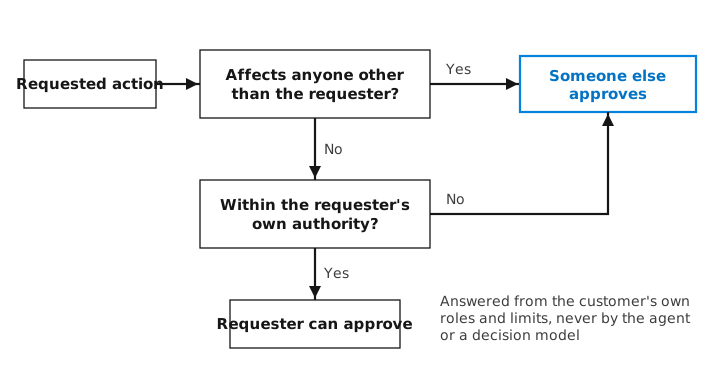
Will the action impact anybody except for the individual requesting it? Or is it outside of their own authority? If the first condition is met with 'yes' or the second with 'no', then someone else must approve it. The product will determine this from the customer's own data on roles and constraints, such as their personnel system or login provider, but never from the agent or a decision model.
Why this protects the person who clicks
If someone approves something that isn't their responsibility, the fault falls on them, as Madeleine Elish calls it the moral crumple zone. We suggest the end-user shouldn't bear this responsibility by default. The UK's data regulator and their financial regulator both require reviewers to have actual authority.
Why the approval can't be a chat reply
If an agent gets approval as a chat response, the person in the chat may give it, and so can the agent. The product really has to ask a fixed question about the precise action involved.
No agent approves, and the check sits in code
If consent was simply a string written out by the model, an agent could effectively authorize things. Authority must come from a person's actual click or a rule outside the model, and when one agent calls on another, the run waits for a human.
What should the approval request and its record show?
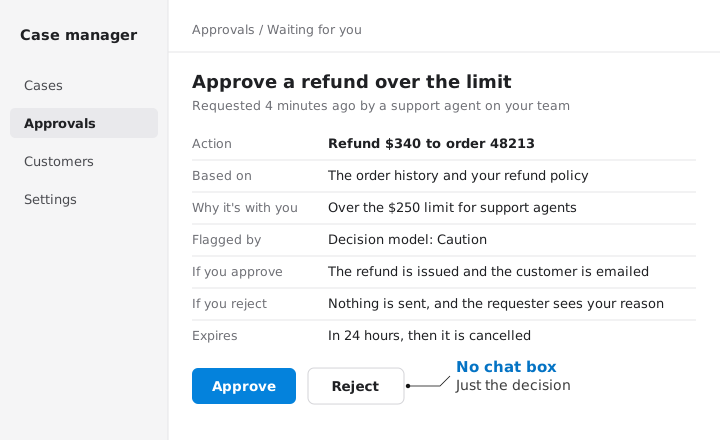
The request will display the exact action involved, the data it's based on, what exactly will be changed and for whom and the permissible answers. The record will store who made the decision, in what capacity, which route they used, what they saw and chose, and what the agent did afterward.
What the request includes
- What the agent plans to do
- To whom or what - and using what data
- Why it's asking - including why a decision model flagged it for review
- Exactly what happens on each possible answer
- When the request will expire
The screen will hold just the decision - without anything for the user to type to the agent. The agent won't even create the form.
How do you stop human-in-the-loop AI agents becoming a rubber stamp?
What the numbers show
"Human in the loop" actually refers to a person approving something before the agent takes any action. Anthropic says people approve nearly 97% of permission prompts, although they don't share their sample size.
However, when a highly dangerous command was embedded, only 143 of 1,053 testers (13.6%) spotted it.
Out of 400 repeat reviewers of the agent's code, approval rates rose from 30.1% to 36.8%, with 22% fewer comments overall. The authors can't rule out the possibility that the agents were actually improving.
The fix: Ask about the whole plan, not just specific tasks
People say no to 39% of plans if they're shown a plan rather than just taking individual actions. So ask about the entire task at once, then ask again beyond the plan's boundaries. Offer a couple of predetermined responses to each item, much like Harrison Chase suggests.
How to set up an AI agent approval workflow
An AI agent's approval workflow actually involves nine stages.
The nine steps
- List every action your agent can perform.
- Indicate whether each one is a read or a write; treat unknowns as writes.
- Apply the test: Could an outside observer see it, and could the end-user reverse it?
- Determine whether your decision model should categorize borderline cases and establish its threshold value.
- Decide who should approve each action using the two authority questions.
- Allow each customer account administrator to adjust these rules to meet their users' needs.
- Send the approval request directly to the screen, showing only the decision.
- Set both the expiration timeframe and the consequence for no response.
- Document who responded and what subsequently occurred as a result of their choice.
Common questions
What is an approval workflow?
An approval workflow is a sequence of stages that sends a request to the most relevant person to accept or reject something before anything happens. For an AI agent, this represents a split-second pause before taking an action that poses a certain level of risk, during which the agent waits for a specified person to decide.
Can an AI agent approve its own actions?
No. In an earlier stage of our project, consent was merely a string produced by the model - therefore, a confused or manipulated agent could quite literally authorize.
Is human approval of AI agent actions required by law?
Not quite as straightforward as that. By October 2026, some laws will require a meaningful human review of specific decisions. The EU's more stringent guidelines will apply starting in December 2027.