AI agent pricing: Moving away from seats without sacrificing margins
· 14 min read · Blog
How to price an AI agent inside an existing SaaS plan: the five pricing models, how to choose one, what each account costs you, and how to protect margin.
Seat prices assume that each user costs the same, and agents don't. This is how software companies price an agent within their existing plans, B2B and B2C, without losing margins on the lowest-paying clients.
In 2023, GitHub Copilot was reported to lose around $20 per user per month on a $10 plan, and some users cost it $80.
The issue is apparent and worrying for any SaaS vendor:
Seat prices assume every user costs the same, and AI agents don't. For certain customers, an agent costs more to operate than they pay; good LLMs cost a lot, and it's hard to optimize for cost without sacrificing quality. Meanwhile, expectations of AI rise, meaning the value you must deliver to command a premium price and protect your margin goes up.
In this article, we will cover what AI agent pricing is, the main pricing models, and how to choose one for an agent integrated into your existing product, packaging, and pricing without sacrificing your margins.
Why do seats no longer work?
AI agent pricing is how a software company charges for an agent that does work for its customers. Seats don't work because each user's cost now varies widely while the price stays flat. And the more work the agent does, the fewer seats your customers need.
Two reasons seats break
Seat pricing is a fixed rate per user per month, regardless of what the user does. Firstly, the cost per user isn't anywhere near zero anymore. Every job consumes model calls, and heavy users consume far more than lighter ones.
Second, with agentic AI, the agent carries out tasks people used to do, meaning clients need fewer seats as your product becomes more effective.
In B2B, one user may run the agent on every ticket while their colleague opens it only twice a week. In contrast, in B2C scenarios, one subscriber may use it continuously throughout the day while another uses it once a day. All at the same price but resulting in a vastly different total monthly expenditure.
Seats aren't dead, though. In Stripe's survey of 200 software leaders, seats as the main pricing model are expected to fall from 16% to 11%. One in four platforms plan to keep seats and charge separately for agent work.
What are the AI agent pricing models?
Five structures account for most AI agent pricing methods: seats, usage, credits, hybrid, and outcome. Most vendors that integrate an agent into their products use a hybrid model: a basic fee plus an additional charge based on usage.
One thing to know before you read the other pages on this topic: most of the vendor-side guides written about "AI agent pricing" are written by billing companies. They lean towards metering because metering is what they sell. We are not trying to sell you any billing software here.
The five models, side by side
| Model | You charge for | Best when | Margin risk to you | Predictable? | Price tracks value? | Example |
|---|---|---|---|---|---|---|
| Seat | A fixed price per user | Use is light and even | High; heavy users can cost you | High | Low | Microsoft 365 Personal (B2C) |
| Usage | Messages, actions, tasks, or tokens used | Cost swings, value follows volume | Low | Low | Medium | Cursor Pro: $20 of usage at API pricing (B2C) |
| Credits | A prepaid allowance spent across actions | You want to price new actions later | Low, if capped | Medium | Medium | Figma (B2B) |
| Hybrid | A base fee plus usage on top | The agent sits inside a plan | Medium | Medium | Medium | GitHub Copilot Business (B2B) |
| Outcome | A defined result, like a resolved ticket | When an agent(s) is delivering on repeatable and specific use-cases e.g. support. | High; you carry retries | Medium | High | Fin AI, Sierra AI, Hubspot (B2B) |
Where outcome pricing fits
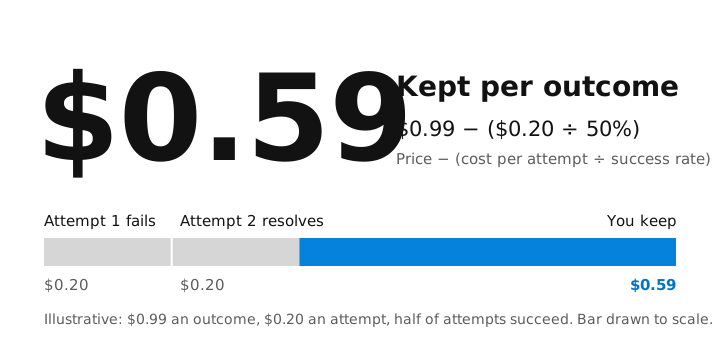
Fin charges $0.99 per outcome in a conversation, once per conversation. HubSpot's agent will charge $0.50 for a resolved conversation. Both models work since the outcome does happen within the vendor's own help desk, as Sierra argues. Run this margin check initially since you'll carry every retry fee: per outcome minus (cost per attempt divided by success rate). At $0.99, $0.20 per attempt and a 50% success rate, you keep roughly $0.59 (illustrative).
Emergence Capital uses two questions to place these models: how independently does the agent work, and how clearly can its results be credited to it? Low on both points to seats. High on both points to outcomes. Manny Medina adds a warning on pricing per action: "Pricing per activity essentially makes you a commodity and prices only go down."
Where pricing is heading
AI agent pricing is moving toward hybrids as we get closer to 2027: currently, 37% of 230 B2B surveyed software and AI companies use hybrids, up from 25% the year before, according to Kyle Poyar's survey.
Rob Litterst found that among about 500 leading software companies with public pricing, those using credits rose from 35 to 79 in 2025. The same group made more than 1,800 pricing changes that year. Established B2B vendors are converging on one answer: a seat plus agent add-on or a per-seat allowance, pooled across the company, with the ability to add more usage on top.
How do you choose an AI agent pricing model for an agent inside your plan?
Determine if the agent is truly worth charging for, then establish what each account costs and choose the lightest framework that maintains your margin. For most agents within a plan, that means including an allocation in the plan, with bring-your-own-key available from the middle tier upward.
Is it worth charging for at all?
Kyle Poyar and Aakash Gupta observe that most AI features fall short on value rather than being too expensive. "AI tourists" will test out the agent, incur costs for you, and then leave before making payment. If that happens 1,000 times a month, that becomes very costly.
On the other hand, an agent may also increase the plan's overall value. You could include the price in the plan (plus other agents or AI features as a bundle) to encourage upsell to the next tier, and your customers will assess the plan's overall return on investment. Or you provide a trial of the agent within the plan, limiting credit usage during the trial. Or make it an add-on.
Questions to help you decide
Scroll down and stop at the first 'yes'.
| Question | If yes |
|---|---|
| Have you measured cost per account for under a month, or not at all? | Bundle with a generous allowance for a fixed period, measure, then price. |
| Will fewer than about 70% of customers use it, and those who do value it highly? | Sell it as an add-on (Palle Broe's rule of thumb). |
| Does the agent finish something you can count in your own system, like a closed ticket? | Price per outcome, with a monthly minimum. |
| Do mid and upper-tier customers already have model provider contracts? | Let them bring their own key; charge a platform or seat fee. |
| Does cost per account vary more than tenfold from median to heaviest? | Add a per-seat allowance, pooled across the account, and sell more allowance. |
| Is use light and evenly spread across seats? | Bundle it and raise the plan price. |
Options for an agent inside a plan
Prices are current as of October 2026. AI pricing changes frequently, so check each vendor's pricing webpage before duplicating any details.
| Option | How it works | Fits when | Margin risk | Example |
|---|---|---|---|---|
| Bundle, raise price | AI for everyone; the rise pays for average use | Use stays light | Heavy users ride free | Notion Business ($15 to $20 a member), Microsoft 365 Personal (B2C) |
| Pooled seat allowance | Seat credits, pooled across the account | Use varies by seat | Worst case capped | GitHub Copilot Business: $19 a month per user, 1,900 credits; Atlassian Rovo |
| Add-on | A separate price for the agent | Few use it, and value it | Heavy users, unless capped | Salesforce Agentforce, $125 per user a month |
| Platform fee plus usage | Product fee, then model use at cost | Customers know their usage, have small customers that need AI and big ones that pay | Margin sits in the fee | Clay (read their internal memo on why they did this) |
| Platform fee, own key, middle tier up | Customer connects its own model account | Larger buyers with provider contracts | Model cost leaves; platform cost stays | GitHub Copilot Business and Enterprise; Warp, with platform credits |
Rob Litterst found that vendors who bundled AI and raised the price added roughly $2.50 to $5 per user. That's safe only while average use stays low.
Bringing your own key works because heavy use lands on the bill of the customer with a budget for it, and your margin stops depending on how hard they use the agent. Some vendors have moved the other way and replaced customer keys with managed credits. Getting, storing and paying for a key is what stalls smaller buyers. That's why it is typically best for a higher-paying, larger customer.
The person using the agent is often also not the person paying. In B2B, the user is your customer's employee, or your customer's own client, and the account owner pays. In B2C, the cost of the heaviest subscribers is spread across everyone else's price.
Price to fit the buyer's budget, and give the buyer control. Most AI spend comes from software budgets companies already have: 70% in Poyar's survey. That's why some enterprises are moving non-technical staff onto the AI that comes bundled with plans they already pay for.
What does each customer cost you to serve?
You need the cost per message and per customer account, with a detailed breakdown of all agent costs (tool calls, skills, system prompt, etc.) plus your non-AI infrastructure costs, before any usage price has meaning. An average per-user cost hides those customers that are losing you money.
The list price isn't what you pay
Model tokens are essentially the billing unit, roughly three-quarters of a word, and a listed model price will tell you very little. Agents resend the entire conversation each round, so nearly all you pay for is input tokens, and much of it can be retrieved from the cache at a tenth of the price.
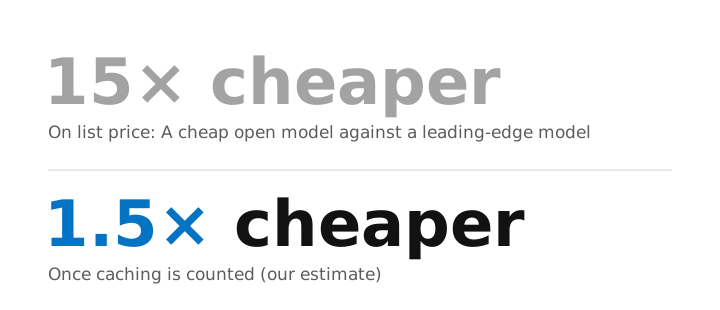
On list prices, a cheap open model looks 15 times cheaper than a leading-edge model. Once caching is factored in, we estimate the gap shrinks to about 1.5 times. In one 16-round test, caching cut the bill by 71%, though that's a single experiment, not a guarantee; it shows you how important caching is.
Evaluate your AI agents' costs based on cost per successful task for your actual task.
Where cost really comes from
| Lever | What drives the cost |
|---|---|
| Rounds | An agent works in rounds: it reads, acts, reads the result, then acts again. Every round resends the whole conversation, so doubling the rounds roughly quadruples the cost. |
| Tools | Every tool you give the agent is sent with every call, whether it's used or not, and every tool call adds another round. |
| Calls you didn't need | Each one costs a full call: the same question answered twice, duplicate submissions, retries of requests that already worked, and answers in the wrong format that have to be asked for again. |
| What you resend | Anything left in the conversation, such as a long tool result, a growing chat history or repeated instructions, is paid for again every round. One oversized tool result can cost about $315 a month, against about $20 for trimming the system prompt (our estimate). |
| Broken caching | Providers charge about a tenth of the price for text they've seen before, but only if it arrives in exactly the same form. |
| Output and thinking | Text the model writes costs roughly five times as much as text it reads, and its thinking is billed as written text. |
| Price per token | List price, which matters less than most teams think. |
| Hidden costs | Test runs, failed runs and human review. One failed run we measured read 15 input tokens for every output token. |
Why do your cheapest customers cost you the most?
A flat-rate plan means giving the same agent to a customer who pays a fraction of the price, and heavy use concentrates exactly where the margin is thinnest.
Two public cases
Anthropic implemented weekly limits after one subscriber on a $200 plan used tens of thousands of dollars in model usage. And Cursor is said to be profitable on its enterprise accounts but lose money on individual developers' accounts.
How to test whether you limit AI usage in your product amongst users and how to fix any problems
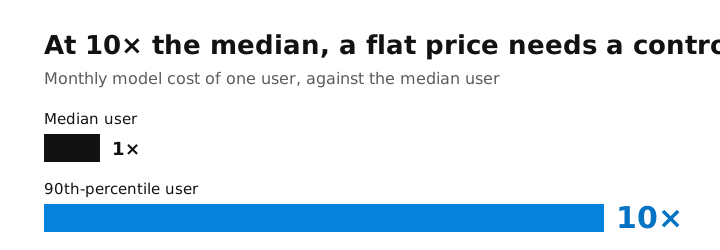
Aakash Gupta's test was this: If your 90th-percentile user costs 10 times your median, you need some form of control. His free-tier check also applied: if your free-to-paid conversion rate drops below 2 to 3%, your free tier is probably too generous. Trace Cohen asks a simpler question: do your margins rise or fall when usage on an account doubles? Your actual task mix determines which side you'll fall on.
Here are six possible solutions:
- Introduce a hard spending limit on lower tiers.
- Use smaller, less expensive models as the default option on lower tiers.
- Set a minimum platform fee so that no account ever costs more than it brings in.
- Include fair-use limits right in your plan.
- Track the costs for each account separately.
- Let users bring their own keys from your middle tier upward.
How do you move existing customers onto new pricing without surprise bills?
Here are the seven steps:
First, measure for a set period. A training provider that sold to hundreds of college clients discovered that a college spending between £20,000 and £25,000 annually wouldn't pay £15,000 for a paid AI add-on. Its potential customer base shrank from hundreds to 10 to 15. It chose 12 months of unlimited use to fully understand the costs involved, then set year two's prices. As a result, it grew very well.
Start with new customers first. Poyar and Gupta suggest trying the new pricing structure on new customers first so any mistakes affect only one group (or 'cohort') of customers, not your entire customer base.
Give existing customers a date and an allowance at least as large as their current use. Figma gave about three months of notice before enforcing credit limits, and more than 75% of its larger customers who went over kept buying credits. The cost still landed on small customers: one solo designer went from paying about $20 to about $55 a month. Atlassian said they'd give 90 days' notice. Clay told existing customers they could stick with their old plan if they wanted to.
Make sure alerts and caps are enabled before that very first bill. Warn them before they hit a limit; don't tell them afterward.
Publicize what a credit or unit actually buys. Display these details on your pricing page in clear figures. Credits aren't really the problem; the issue is that you're not explaining what they buy and why that causes problems.
Publish the memo like Clay did, with openness and transparency. Gone are the days of pricing that people don't understand and that makes them feel greedy. Be open, clear and transparent about pricing so everyone understands why you are doing it.
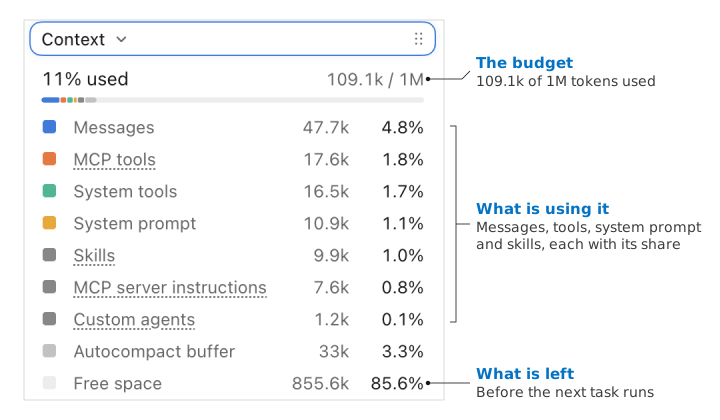
If you do go by usage, give users a way of tracking what they are spending or about to spend before they ask the agent to complete the task. Give them the information and choice, so they feel in control. Claude is increasingly providing these capabilities (see image, from the Claude Code desktop app).
Keeping the bill predictable
Your customers will worry far more about surprise bills than about one being extremely high. Set your price in terms of things your customers will recognize: such as a business task, a document or even a conversation, all billed per task rather than per token. Elena Verna says quite simply: "Nobody wakes up wanting 500 million tokens."
If you're operating in a B2B environment, give your admin users a view of how often your software is used, along with a budget for agents with limits.
In a B2C environment, display the user's remaining allowance right within the product. Poyar says the fear of runaway bills in procurement is the biggest barrier to credits. Alex Turnbull says a supplier took his $2,900 plan to $14,094 in one month through overage, with no alerts.
What went wrong elsewhere
Cursor substituted requests with a usage limit. Customers were surprised by bills; the CEO apologized, and charges were refunded. Australia's regulator sued Microsoft, claiming it had concealed a less expensive plan, one that didn't rely on artificial intelligence, from individuals whose subscriptions were set to automatically renew.
The lesson? Be as open, proactive, and honest as possible. In a world where everyone is using LLMs, software vendors must show users they are not adding margins on top of the LLM without adding any value.
What gross margin should you expect on an AI agent?
If you read about margins for AI companies now, they seem small. That is the current problem to overcome, not the benchmark you should let yourself be guided by.
If the agent sits inside a plan that already runs at software margins, decide how many points of that margin the agent may cost you. Set a floor that no account falls below, and plan for the gap to close as model costs fall.
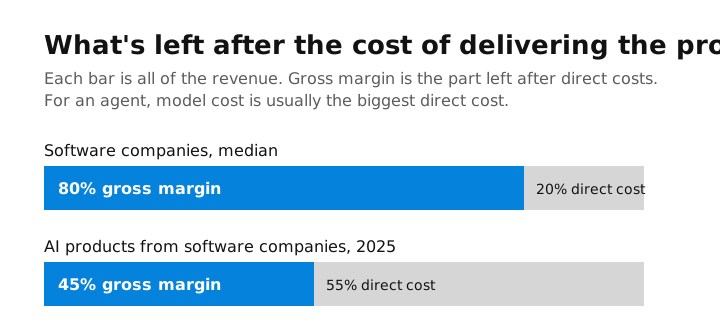
Gross margin is revenue minus the direct cost of delivering the product, expressed as a percentage of revenue. For an agent, model cost is usually the biggest direct cost. Here is how to set your target:
- Set it on the whole plan, not on the agent. One SaaStr Fund company at $100M ARR planned about $6M of extra model cost over a year, roughly 6% of the margin.
- Set a floor per tier and per account, not an average. No account should cost more to serve than it pays.
- Let packaging set the margin. When customers bring their own key, model cost leaves your cost base and your margin sits in the platform fee. On your own keys, a hard allowance protects it.
- Plan for it to rise. The cost of a model at a fixed level of performance falls about 10 times a year, but cost per task falls much more slowly because agents use more tokens on each task.
Margin benchmarks
These figures show where others are now. Use them to check your target, not to set it.
| Who | Gross margin | Kind of figure |
|---|---|---|
| Software companies | Median 80%; AI has not lowered it at the median yet | Survey of 342 companies, 2025 figures (Benchmarkit via Aleph) |
| AI products from software companies | 45% in 2025; 53% projected for 2026, 59% for 2027 | Survey of about 305 executives (ICONIQ via SaaStr) |
| Target margin on AI products | Median about 50%; 12% target 80% or more | Survey of about 230 companies (Poyar) |
| Microsoft Cloud | 68%, guided to about 66%, down due to AI investment | Company-reported (Microsoft earnings call) |
| A software company adding AI | About $6M of extra model cost on $100M of revenue, roughly 6% | Anecdote, estimated (SaaStr) |
These are company-level figures. Your margin by tier, and by account, matters more.
Common questions
What is the best AI agent pricing model for a software company?
Mostly a combination of things: a plan price that already includes an allocation, plus additional use or credits on top. First, determine your per-account costs. Bundle when use is light, then sell heavier use separately, or let larger clients have their own key if needed.
Should you price an agent per seat?
Only when use is light and consistent; seats remain relevant, but many businesses retain them, heavy users ride free, and customers will need fewer seats as the agent performs more tasks. Consider adding a shared allocation per seat to your plan.
Who should own AI agent pricing?
We advise having one named owner who works closely with your finance and product departments. Finance provides the cost per account while product has a clear understanding of what your customers truly value. Without per-account cost data, nobody can properly justify the price.
How much should an AI agent cost?
Price at least your actual cost of provision at the lowest tier, plus the margin you have chosen for the plan. Set that margin on the whole plan and on each account, not by copying an industry average. Avoid simply copying a competitor's listed price; they may be losing money doing so.